

DSCR loans in Las Vegas — qualify on the rent, not your tax returns.
Finance investment property on the home's cash flow — no W-2s, ~20–25% down, close in an LLC, scale past the 10-property cap. Lending in 32 states and DC from Las Vegas.
Quick answer — A DSCR loan is a business-purpose mortgage for investment property in Las Vegas that qualifies on the property's rental income instead of your personal income — no tax returns or W-2s. It is for non-owner-occupied property only; you cannot use one for a home you will live in. Lenders divide the monthly rent by the full payment (PITIA); a DSCR of 1.0 or higher means the rent covers the loan. Las Vegas asking rent is about $1,900/month (Zillow, July 2026), so many Clark County single-family rentals pencil at or near a 1.0 DSCR depending on purchase price and rate.
(A property you partly use yourself may be a second home, not an investment — the difference decides the whole loan: second home vs investment property.)
Reviewed by Vatche Saatdjian · Las Vegas mortgage expert since 2004 · NMLS #69363
How does a DSCR loan actually work?
DSCR stands for debt-service coverage ratio, and in plain terms, a DSCR loan is a rental property loan that qualifies on the property's own rent instead of your personal income or tax returns. Investors search this out because it means a landlord with strong rental cash flow can close even when a traditional income-based file would stall. Mechanically, a DSCR loan works in three moves: divide the property's rent by its full payment to get the ratio, qualify on that ratio instead of your income, then close — often in an LLC — and repeat. It is a business-purpose loan for investment property only, never a home you will live in. In the mortgage industry, DSCR loans are categorized as non-QM (non-qualified mortgage) financing — programs that sit outside Fannie Mae and Freddie Mac's agency guidelines because they qualify a borrower on something other than employment, tax returns, and a debt-to-income ratio.
The product mechanics are identical wherever you buy — our nationwide guide to DSCR loans covers the program itself end to end, while this page focuses on how it plays out in the Clark County market.
"Your debt-to-income ratio (DTI) is all your monthly debt payments divided by your gross monthly income."Consumer Financial Protection Bureau — consumerfinance.gov/ask-cfpb
On a conventional loan that DTI decides whether you qualify. A DSCR loan swaps it out entirely — the property's coverage ratio does the qualifying, so your personal DTI never enters the file.
Run the numbers
Divide the property's monthly rent by its full payment (PITIA). That ratio is your DSCR — 1.0 means the rent covers the loan.
Qualify on the property
No tax returns, W-2s, or pay stubs — it's a business-purpose loan. Plan on ~20–25% down and roughly 620+ credit.
Close & scale
Fund in an LLC for privacy and protection — then do it again. DSCR programs generally have no cap on financed properties.
How do you calculate DSCR?
Divide the property's gross monthly rent by its full monthly payment — PITIA (principal, interest, taxes, insurance, and any HOA dues). A result of 1.00 means the rent exactly covers the payment; higher is stronger. Here's the math on a Las Vegas example, then a calculator you can run against your own numbers. For the full mechanics — which rent a lender actually credits, every line inside PITIA, and the miscalculations that sink files — read how DSCR is calculated, step by step.
A worked example, step by step
Say you're buying a $290,000 Clark County single-family rental with 25% down ($72,500), leaving a $217,500 loan at an illustrative 7.5% rate on a 30-year term. That rate is an example for the math only — not a quote, offer, or commitment to lend.
- Principal & interest (P&I)
- ≈ $1,521 / mo
- + Property taxes (illustrative)
- $180 / mo
- + Landlord insurance (illustrative)
- $95 / mo
- + HOA dues
- $0 / mo
- = Full payment (PITIA)
- ≈ $1,796 / mo
- Market rent (Zillow, Las Vegas, July 2026)
- ≈ $1,900 / mo
DSCR = $1,900 rent ÷ $1,796 payment ≈ 1.06. The rent covers the payment with a little to spare, so this file can qualify — though pushing the ratio toward 1.25 (more down, a lower price, or higher rent) is what earns the strongest pricing.
Illustrative math only, rounded to the nearest dollar. Not a rate quote, pre-approval, or commitment to lend. Actual payment, taxes, insurance, rent, and DSCR vary and are subject to underwriting.
Estimate only, based on the figures you enter. Not a rate quote, pre-approval, or commitment to lend. Actual DSCR, rates, terms, and eligibility are determined by the lender and subject to underwriting.
What do DSCR programs commonly require?
If you're asking how to qualify for a DSCR loan, the file leans on the property, not your paycheck. DSCR programs commonly require about 20–25% down, a credit score in the low-to-mid 600s or better, and a few months of cash reserves — with no income documents at all. Guidelines vary by lender and are subject to underwriting; here's the typical shape of a file, similar to what a self-employed borrower sees. For the full picture — reserves, entity vesting, property eligibility, and the exact documents to gather — see DSCR loan requirements in Nevada. Two working tools sit alongside it: a checklist for screening a candidate address before you write, and a way to size reserves in months of PITIA.
- DSCR target: 1.0 can fund · 1.25+ earns the best pricing · a no-ratio option exists below 1.0.
- Down payment: ~20–25% (sometimes 15% at strong DSCR + credit); LTV commonly to 75–80%.
- Credit: roughly 620–680+ FICO floor; better pricing as the score rises.
- Property: non-owner-occupied 1–4 unit, plus many condos, 5–8 unit, and short-term rentals.
- Reserves: typically about 6 months of payments (varies by program).
- Vesting: commonly close in an LLC for asset protection and privacy.
Income docs aren't required because DSCR loans are business-purpose investment loans — generally exempt from the consumer ATR/QM rule under Reg Z (12 CFR 1026.3(a)).
Why do Las Vegas investors choose DSCR loans?
Las Vegas investors choose DSCR loans for three reasons: they skip income documents, they can close in an LLC, and they aren't capped at 10 financed properties — so a portfolio can keep growing past what conventional financing allows.
No income docs
No tax returns, W-2s, or pay stubs. Underwritten to the property's rent — ideal for self-employed and 1099 investors.
Close in an LLC
Vest title in your entity for privacy and asset protection — a structuring advantage conventional financing rarely allows.
No 10-property cap
Conventional financing caps you at 10 financed properties (Fannie Mae). DSCR programs generally don't — scale the portfolio.
Is a DSCR loan better than a conventional investment loan?
Neither is universally better: a DSCR loan wins when you're self-employed or scaling a portfolio, while a conventional investment loan usually prices lower if you have the income documents and are under 10 properties. Above the Clark County conforming limit the choice narrows again, and our Las Vegas jumbo loan guide covers what changes when the balance itself is the constraint. The core difference is what you qualify on, and our full breakdown of DSCR versus conventional investment-property financing in Nevada walks both qualification tests, the documents each path demands, and the 10-property conventional ceiling side by side. Illustrative comparison — terms vary by lender and are subject to underwriting.
| Factor | DSCR loan | Conventional investor loan |
|---|---|---|
| Qualifies on | The property's rent (DSCR = rent ÷ PITIA) | Your personal income + DTI |
| Income docs | None — business-purpose | 2 yrs returns, W-2s/1099s, pay stubs |
| Typical down | ~20–25% (sometimes 15%) | ~15–25% for investment property |
| Financed-property cap | Generally none — scale a portfolio | 10 financed properties max (Fannie Mae) |
| LLC vesting | Commonly allowed | Generally must close in your name |
| Short-term rental | Often allowed (varies) | Restricted / case-by-case |
| Rate posture | Higher; prepay penalty common | Lower; no prepay penalty |
| Best for | Self-employed; portfolio scaling | W-2 buyers under 10 properties |
Sources: Fannie Mae Selling Guide B2-2-03 (10 financed-property limit, effective 11/05/2025); Regulation Z 12 CFR 1026.3(a) (business-purpose exemption). As of July 2026.
DSCR loans skip the income-doc rules because they're business-purpose credit — the category Regulation Z carves out by name: "An extension of credit primarily for a business, commercial or agricultural purpose."12 CFR 1026.3(a)(1), Regulation Z — ecfr.gov
The BRRRR loop, powered by a cash-out refi.
Buy, improve, rent, then pull your capital back out with a DSCR cash-out refinance — and do it again. If the property you are tapping is the home you live in, the Las Vegas cash-out refinance rules for an owner-occupied file apply instead. And if you built the rental rather than bought it, the same refinance step becomes the DSCR takeout that pays off a construction loan once the house is finished and rentable. The rehab step has its own financing question — what a rehab loan on a Las Vegas investment property can and cannot cover depends on whether the work fits agency renovation guidelines.
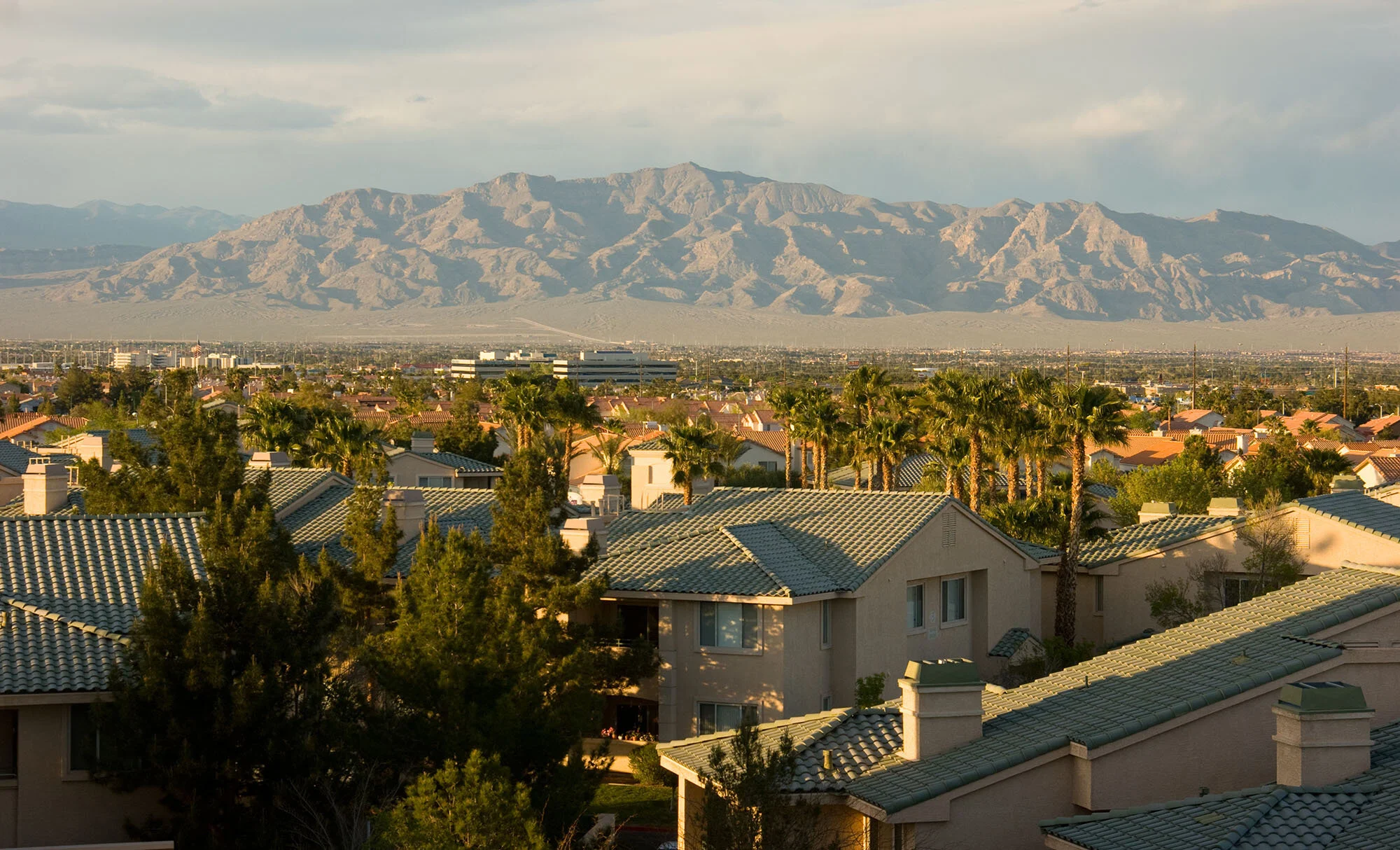
Nevada & Las Vegas investors: Clark County's rental demand makes DSCR a natural fit for Summerlin, Henderson, North Las Vegas and Spring Valley rentals. We're a local Las Vegas mortgage lender pricing DSCR files with a local team — from everyday Las Vegas home loans to portfolio DSCR deals, lending in 32 states and DC.
Does the rent in Las Vegas actually pencil at DSCR?
It depends on the price you pay. Las Vegas asking rent is about $1,900/month for a typical home in 2026 (Zillow, July 2026). Whether that covers the PITIA depends on your purchase price and rate. Here's the math at four price points — using an illustrative 7.5% rate, 25% down, and a 30-year term, with the rent held near the metro-typical figure to isolate the effect of price. Estimates only.
| Purchase price | Down (25%) | Loan amount | Est. PITIA (illus.) | Market rent ~$1,900 | Est. DSCR |
|---|---|---|---|---|---|
| $240,000 (NLV) | $60,000 | $180,000 | ~$1,470 | $1,900 | ~1.29 |
| $270,000 | $67,500 | $202,500 | ~$1,645 | $1,900 | ~1.15 |
| $320,000 | $80,000 | $240,000 | ~$1,940 | $1,900 | ~0.98 |
| $380,000 | $95,000 | $285,000 | ~$2,295 | $1,900 | ~0.83 |
Estimates assume an illustrative 7.5% rate, 25% down, 30-year term; PITIA includes estimated property taxes (~0.6% of price per year) and landlord insurance. A higher-priced home usually commands higher rent, which lifts its DSCR — this table holds rent near the metro-typical figure to show the effect of price alone. Rent source: Zillow, Las Vegas, July 2026; DSCR calculation is illustrative only. Not a rate quote, commitment to lend, or guarantee of rental income. Subject to underwriting.
NMLS #65506. Equal Housing Opportunity. Valley West Mortgage is a local Las Vegas mortgage lender, not a property management service. Rental income projections are estimates and not guaranteed.
Can you use a DSCR loan for an Airbnb or VRBO in Las Vegas?
Yes — some DSCR programs allow short-term rental (STR) income to qualify, typically using a market rent estimate from an appraiser’s 1007 Rent Schedule or an Airbnb income report. Las Vegas is one of the highest-grossing short-term rental markets in the U.S. due to year-round tourism and proximity to the Strip, which can push STR income significantly above long-term rents in the right neighborhoods. However, not all DSCR programs accept STR income — program availability and qualifying rent methodology vary by lender. Subject to underwriting, and to Clark County's short-term-rental rules, which are in active legal flux (see below).
For the full picture — how lenders actually underwrite Airbnb and VRBO income, why most files qualify on long-term market rent, and where Clark County's licensing case stands — read our deep dive on short-term rental financing in Las Vegas.
Key considerations for Las Vegas STR DSCR
- STR rules are in flux: Clark County built a short-term-rental licensing framework (Chapter 7.100), but a December 2025 federal injunction paused its licensing and penalty enforcement while the county appeals, and new-license applications have been closed under a moratorium since 2023. Confirm the current rules with Clark County before you count on STR income.
- Qualifying income method: Some programs use 12-month Airbnb/VRBO income history; others use a 1007 short-term market rent appraisal. Methods vary by program.
- Higher rate possible: STR DSCR programs may carry a rate premium over standard DSCR. We compare programs so you see the full cost. Subject to underwriting.
- Insurance: STR properties require landlord/STR-specific insurance, which affects your PITIA calculation. Valley West Insurance can quote STR coverage alongside the financing. Get an insurance estimate.
STR DSCR program availability, income methodology, and qualifying standards vary by lender and are subject to change. Not a commitment to lend. Subject to credit, income, property, and underwriting approval. NMLS #65506. Equal Housing Opportunity.
Who should — and shouldn't — use a DSCR loan?
A DSCR loan fits investors who qualify better on a property's rent than on their own paperwork, and who plan to keep buying. It's the wrong tool for a home you'll live in, or when a lower-cost conventional loan is within reach. Here's the honest split. If a file has already come back declined, the reasons these applications get turned down are usually fixable before the next attempt.
A DSCR loan fits you if…
- You're self-employed, 1099, or a business owner whose tax returns understate your real income.
- You already own several rentals and are near or past the conventional 10-property cap.
- You want to vest title in an LLC for privacy and asset protection.
- The property's rent covers the payment — a DSCR at or above 1.0.
Look at another option if…
- You're buying a home to live in — a DSCR loan can't be used for a primary residence; use a conventional, FHA, or VA loan.
- You have clean W-2 income and are under 10 properties — see when conventional investment financing beats DSCR, including the 2026 down payment, reserve and refinance ceilings.
- You're buying a getaway you'll use yourself — a second-home loan may fit better.
- You have large liquid assets but little income — an asset-depletion loan can be an alternative.
Not sure which path fits your situation? Talk to the local team or review the full conventional loan requirements to compare income documentation needs.
Educational only. Guidelines vary by program and lender. Subject to credit, income, property, and underwriting approval. NMLS #65506. Equal Housing Opportunity.
DSCR loans, answered.
Investing as a veteran or after an FHA house-hack? See DSCR for veteran investors and DSCR after an FHA house-hack.
Sources
- Fannie Mae, Selling Guide B2-2-03, Multiple Financed Properties for the Same Borrower (effective 11/05/2025) — selling-guide.fanniemae.com
- Consumer Financial Protection Bureau, "What is a debt-to-income ratio?" — consumerfinance.gov
- Regulation Z, 12 CFR 1026.3(a) — business-purpose credit exemption — ecfr.gov
- Clark County, NV — Short-Term Rentals (Chapter 7.100; enforcement paused by a December 2025 federal injunction, county appealing) — clarkcountynv.gov
- Zillow — Las Vegas, NV rental market data (as of July 2026).
Read what buyers say.
Customer experiences may vary. Reviews do not guarantee loan approval, rates, terms, or outcomes. Read current Google reviews.
Run the numbers on your property.
Tell us about the property and we will come back with a clear read on the DSCR and what it would take to finance it. Business-purpose investment loans only — these are not for a home you intend to live in.
Qualify on the rent.
Get pre-approved.
One application, a local Las Vegas mortgage lender, and a clear read on your DSCR — purchase or cash-out refinance, close in an LLC, no property cap.